


Machine-Based Cosmetology vs. Face Cream: What Actually Delivers Results
Why face creams do not reach the deeper layers of the skin, whereas machine-based technologies do. We explain the difference and share clinical research data on Hydrafacial.
“I’ve already tried ten of the most expensive creams, and there’s no result” is one of the most common disappointments women encounter. The issue usually isn’t with a specific product, but with unrealistic expectations: creams can only address “surface-level” concerns. Machine-based cosmetology, on the other hand, tackles problems at a structural level in the deeper layers of the skin.
To understand why a pricey cream might fail to deliver the expected effect while a machine-based treatment can yield noticeable results in a single session, it helps to examine the skin depth each target.
At What Depth Creams Work vs. Machine-Based Treatments
Creams and Serums: Surface-Level Action
Active molecules in most creams and serums are physically incapable of penetrating deeper than the stratum corneum — the outermost layer of the epidermis. This isn’t a flaw of a specific brand, but a limitation of the format: the molecules are simply too large to cross the skin barrier on their own. As a result, creams and serums are great for hydration, supporting the protective barrier, and gently improving skin tone, but they cannot lift facial contours or eliminate deep wrinkles — simply because they don’t reach the layers where those adjustments occur.
Machine-Based Cosmetology: Deep Layer Impact
Machine-based technologies — vacuum, ultrasound, light pulses, radiofrequency — work differently: they act on the dermis, and some modalities even reach the subcutaneous tissue. Machine treatments trigger internal processes, improve microcirculation, and accelerate cell regeneration. That is why the results of machine-based procedures are visible faster and last longer than skincare products that only work as long as you use them.
However, even machine-based cosmetology cannot reverse every change (especially age-related ones) and cannot compete with plastic surgery. Machines cannot fix very deep nasolabial folds or significant amounts of sagging skin — in those cases, surgical intervention is required. Machine-based techniques are most effective where the concern relates to skin tone, texture, hydration, or the condition of the superficial and middle layers of the dermis.
American Technology Hydrafacial: Cleansing, Hydration, and Nourishment in One Session
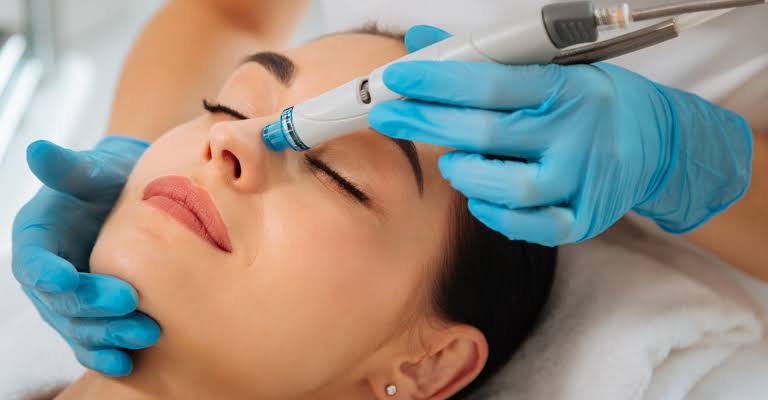
Hydrafacial is an example of a premium machine-based technology that combines multiple mechanisms of action into a single protocol. At its core is patented Vortex-Fusion® technology: a painless vacuum stream combined with HydroPeel® spiral tips simultaneously extracts impurities from pores while delivering hydrating and nourishing serums and boosters into the skin.
The key difference compared to creams and serums lies not only in the depth of penetration, but also in the delivery mechanism: the serum is applied to pre-cleansed and exfoliated skin, allowing it to be absorbed far more effectively than when applied over unprepared skin at home. The protocol is customizable — the esthetician selects the chemical peel, boosters, and additional stages (such as lymphatic drainage or LED therapy) based on the client’s skin condition.
What Clinical Studies on Hydrafacial Show
The effectiveness of this technology has been tested in several studies.
- Skin Hydration (13 weeks). 89% of study participants noted an increase in skin hydration. 100% were ready to recommend the procedure to family and friends. After a course of 4 treatments, a 66% increase in hydration, a 55% reduction in pore size, and a 38% reduction in fine lines and wrinkles were recorded.
- Acne Care (12 weeks). 100% of study participants agreed that their skin looked clearer and healthier.
- Facial Skin Rejuvenation (6–9 weeks). Histological and clinical indicators confirmed improvements in skin condition, with no adverse reactions or complications reported.
It’s important to understand the context of these numbers: these are research results based on specific durations and treatment courses, not a guarantee of identical results for every client. The final outcome depends on initial skin condition, the number of sessions, and supporting home care as recommended by an esthetician.
When a Cream or Serum Is Enough vs. When to Consider a Machine-Based Treatment
Creams and serums remain the foundation of daily skincare — hydration, skin barrier support, and prevention. A machine-based procedure should be considered when the goal goes beyond surface care: enlarged pores, uneven skin tone, hyperpigmentation, deeper dehydration, or loss of firmness.
To clearly illustrate which tool handles specific concerns more effectively, see the table below.
| Concern | Creams / Serums | Machine-Based Treatments |
| Hydration & Maintaining Tone | ✅ Effective — this is their main job. | ➕ Can enhance results, but not the main goal. |
| Mild Expression Lines | ✅ Can slightly smooth them out. | ✅ Effective; stimulate skin renewal. |
| Deep Wrinkles & Folds | ❌ Cannot penetrate deep enough. | ✅ Effective. |
| Ptosis (Sagging Tissues), Loss of Contour | ❌ Ineffective. | ✅ Effective. |
| Hyperpigmentation, Spider Veins | ❌ Ineffective against deep pigmentation. | ✅ Effective. |
| Scars, Post-Acne Marks | ❌ Ineffective. | ✅ Effective. |
| Speed of Results | Slow; requires continuous use. | Fast — results are visible after the first session. |
| Duration of Effect | Only as long as the product is used. | Long-lasting — triggers the skin’s natural renewal processes. |
The best outcome usually comes not from an “either/or” choice, but from a combination: quality home care extends and maintains the results achieved from a course of machine-based treatments.
Frequently Asked Questions
Can Hydrafacial be replaced by home care?
No. At-home products work on a surface level and cannot offer the same pore cleansing or active ingredient delivery provided by Vortex-Fusion® vacuum-vortex technology. Creams, serums, and machine treatments complement rather than replace one another.
How many Hydrafacial sessions are needed for noticeable results?
Clinical data shows tangible improvements after just the first session, with longer-lasting results achieved through a series of multiple treatments. The exact number and frequency are determined by an esthetician based on skin condition and individual goals.
Is Hydrafacial suitable if I already have deep wrinkles?
The technology is effective for superficial and medium-depth wrinkles and overall skin condition. For very deep creases and pronounced ptosis, it is worth discussing a combination of modalities or other options with an esthetician — machine cosmetology works as part of an overall strategy here.
Is this technology safe for sensitive skin?
According to research, no adverse reactions or complications have been reported, and the treatment is adaptable for sensitive skin. Final contraindications are evaluated by an esthetician during a consultation prior to the treatment.
Face creams and machine-based procedures fulfill different skin needs: one supports the surface barrier, while the other influences deeper processes that dictate firmness, texture, and tone. Hydrafacial combines cleansing, nourishment, and hydration in a single protocol, and clinical study results offer a clear picture of what to expect from a course of treatments. Therefore, the most grounded approach is not to pit home care against machine-based cosmetology, but to combine them: daily cream application maintains the results, while a customized Hydrafacial course addresses concerns that creams simply cannot solve on their own.